
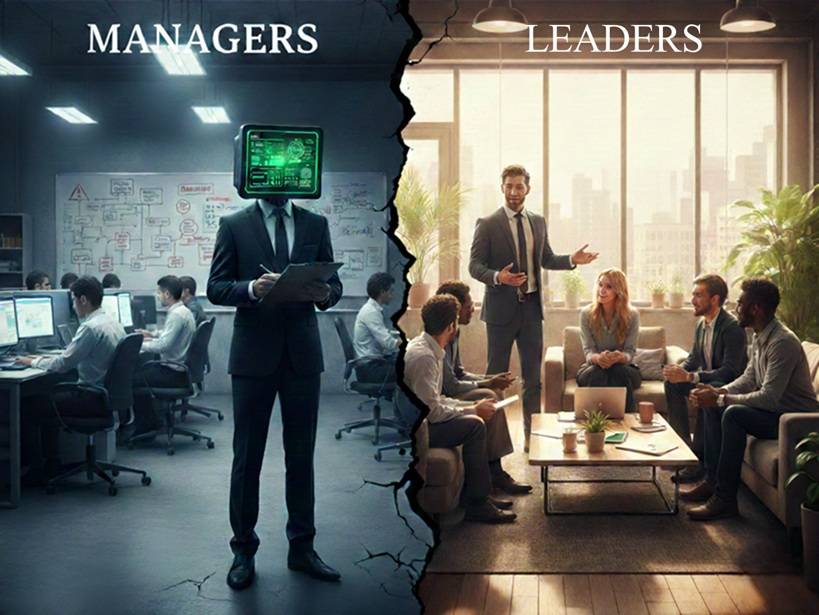
Your Leadership Training Is Creating Managers, Not Leaders—Here’s Why (Part 1)
Why organizations keep promoting the wrong people, and what it costs them.
I once worked for someone who managed processes flawlessly. Every program ran on
time. Metrics were consistently green. Briefings, without exception, were polished.
However, despite flawless execution, they were one of the worst leaders I’ve ever served under.
After I gave up an in-residence school slot to deploy, a significant career sacrifice, I
worked to line up another opportunity when I returned. Everything was arranged. All I
needed was their approval.
Instead of supporting me, When I asked for support, I was labeled self-centered and accused of caring only about optics. The context — including a significant career sacrifice — never entered the conversation. The fact that I’d sacrificed the original slot to deploy? Irrelevant.
As a result, I never attended that school in-residence.
After they retired, I learned they’d nearly been fired for poor decision-making. They
played favorites. Rules applied selectively. As a result, trust became a transaction, not a foundation.
Leadership training focuses on skills, frameworks, and processes.
Leadership development focuses on judgment, character, trust, and long-term influence.
Most organizations confuse the two — and pay the price.
Here’s what struck me: this person had completed every leadership course the Air
Force offered. The frameworks were familiar to them. Principles came easily in conversation. But when
it mattered, when a real person needed real leadership, they failed.
And they’re not alone.
The Million Dollar Question Nobody’s Asking
Organizations spend millions on leadership development every year. Courses,
certifications, workshops, retreats. Yet when I talk to business owners and executives,
they tell me the same thing: “We can’t find good leaders.”
The problem isn’t a talent shortage. Instead, it’s a systems failure.
As a result, organizations keep repeating the same leadership mistakes.
We’re not developing leaders. We’re producing managers who’ve memorized the script
but missed the point entirely.
Here’s why.
Problem 1: We’re Training Compliance, Not Judgment
Leadership training teaches people what to do. It rarely teaches them how to think.
I watched a Lieutenant who was technically competent at managing programs but
couldn’t navigate the human complexity of leadership. When they didn’t get the perks
they felt entitled to, they threatened the acting branch chief.
Think about that. Someone trained in leadership fundamentals resorted to threats when
they didn’t get their way.
I advised the branch chief not to cave. They called the bluff and the Lieutenant backed
down.
In reality, this wasn’t a knowledge problem. This person understood management principles.
What they lacked was judgment, the ability to read a situation, understand power
dynamics, and recognize that leadership is earned, not demanded.
In practice, you can’t teach judgment in a classroom. You develop it through experience,
mentorship, and repeated exposure to situations where there is no clear playbook. But
most leadership training focuses on the playbook, not the capacity to know when to
throw it out.
As a result, leaders follow the process right up until they face a situation the process doesn’t cover.
Problem 2: We Promote Technical Excellence, Then Wonder Why They Can’t Lead People
Here’s the pattern I’ve seen repeatedly: Someone excels at their technical role. They hit
every target. They solve every problem. So, we promote them.
Yet, we act surprised when they can’t develop others, can’t build trust, or create the culture that made them successful in the first place.
The assumption is that technical mastery transfers to leadership capability. It doesn’t.
I worked with brilliant officers who could manage complex programs flawlessly but
couldn’t have an honest conversation with a struggling team member. I’ve watched
exceptional performers become mediocre leaders because nobody asked whether they
had the capacity, or the desire, to multiply their excellence through others.
The promotion system rewards individual achievement. Then it hands those high
achievers a team and expects them to immediately shift from “I execute” to “I enable
others to execute.”
Most can’t make that shift. Not because they’re incapable, but because we never
assessed for it, never developed it, and never made it clear that leadership is a
fundamentally different job than the one they were promoted from.
The cost: Your best technical talent becomes your weakest leadership layer. High
performers leave because they’re led by people who don’t know how to lead. And the
cycle continues.
Problem 3: We Measure What’s Easy, Not What Matters
In the Air Force, command tours typically last two years. That’s when the clock starts.
You have six months to build trust, establish culture, execute the mission, and begin to
develop your people. After that, you’re part of the problem.
Some commanders do this brilliantly. They quickly gain buy-in. They turn broken
cultures around or make good cultures better. People want to work for them. Attrition
drops. Performance improves.
Others survive the full two years but struggle every day. They check the boxes. They
manage the programs. The organization limps along but trust never forms. People
disengage. The good ones leave.
The third group gets relieved because a higher-level commander loses faith in their
ability to lead effectively.
Here’s what’s telling: the length of time someone serves in a leadership role tells you
nothing about their effectiveness. The measure that actually matters is what happened
to the culture and the people.
Did attrition drop or spike? Do people speak positively about the leader after they’re
gone, or do they breathe a sigh of relief? When given the choice, would team members
follow that leader to their next assignment?
As a result, most organizations don’t measure these things. They measure tenure, project
completion, and revenue targets. All of which can be achieved while culture quietly
deteriorates.
Leadership training programs make the same mistake. They measure course
completion, test scores, and certifications. They don’t measure whether the person
actually became someone others want to follow.
You can graduate top of your leadership class and still be the person everyone hopes
gets transferred.
Problem 4: We Teach Frameworks Instead of Principles
I’ve lost count of how many leaders I’ve met who can recite the “feedback sandwich” but
have no idea why feedback matters in the first place.
They know the technique: positive comment, constructive criticism, positive comment.
What’s missing is the understanding that feedback without trust is just noise.
Often, body language signals disbelief long before words do.
At its core, empathy isn’t a tactic — it’s genuine care for what drives performance.
In theory, frameworks are useful when you understand the underlying principle.
However, without that understanding, they’re just theater.
The boss who called me self-centered probably learned about “difficult conversations” in
a leadership course. They might have even practiced the framework. But they missed
the principle: leadership is about developing people, not punishing them for ambition.
The Lieutenant who threatened the branch chief likely learned about “assertiveness”
and “advocating for yourself.” But they missed the principle: influence comes from
credibility, not coercion.
When we teach frameworks without principles, we create leaders who know what to say
but not when to say it, who to say it to, or why it matters.
The danger: People see through it immediately. And once they realize their leader is
performing leadership rather than practicing it, trust collapses.
Problem 5: We Prioritize Short-Term Results Over Long-Term Culture
New leaders feel immense pressure to “make their mark” quickly. Prove they deserve
the promotion. Show results. Demonstrate impact.
That pressure often leads them to optimize for what’s visible and immediate:
deliverables, metrics, quick wins.
What gets sacrificed? Ultimately, it’s the harder, slower work of building trust, developing people, and creating a culture that sustains performance long after they’re gone.
I’ve watched leaders make decisions that make a goal but break something
fundamental in how the team operated. I’ve seen them take credit for work they didn’t
do, throw team members under the bus to protect their image, or ignore festering
problems because addressing them would require admitting something was broken on
their watch.
The tragedy is that many leadership training programs reinforce this. They teach new
leaders to establish credibility through early wins. They emphasize “first 90 days”
strategies that focus on visible achievements.
What they don’t teach: trust is built through consistency over time, not through
impressive debuts. Culture is shaped by what you do when nobody’s watching, not by
what you announce in all-hands meetings.
The outcome: Leaders who look good in the short term but leave damage in their
wake. And by the time the damage becomes obvious, they’ve already been promoted to
their next role.
The Real Cost
Here’s what this system produces:
- Teams that execute well when someone’s watching but collapse under pressure
- High performers who leave because they’re tired of being managed by people who can’t lead
- A leadership pipeline full of people who know how to run meetings but not how to build trust
- Cultures that look healthy on paper but are quietly eroding
The financial cost is staggering. Gallup’s State of the American Manager report found
that one in two employees have left their job to get away from their manager at some
point in their career (https://www.gallup.com/services/182138/state-american-
manager.aspx). When you factor in recruitment, onboarding, lost productivity, and
institutional knowledge walking out the door, poor leadership is one of the most
expensive problems most organizations refuse to fix.
But the deeper cost is harder to quantify. Teams that could have been exceptional end
up as adequate. Leaders who could have grown but plateaued. Organizations that could
have built something lasting but optimized for the next quarterly report.
The Uncomfortable Truth
If your leadership training program could be replaced by a checklist, you’re not
developing leaders. You’re scaling mediocrity.
The gap between managers and leaders isn’t knowledge. It’s judgment, character, and
genuine care for people. Most leadership training assumes you can teach these things
in a classroom.
You can’t.
Modeling these qualities is possible. At the same time, demanding them is necessary.
Ultimately, promotion decisions must reflect whether those qualities are actually demonstrated. None of this can be downloaded through a certification program.
The question isn’t whether your organization invests in leadership development.
It’s whether what you’re calling “leadership development” is actually producing
leaders people want to follow.
In Part 2, I’ll show you what actually works—how to build a system that develops real
leaders, not just certified managers.
Because the problem is clear. Now let’s fix it.
(Here’s a link to an article you should also read: 10 military leadership traits much needed in the business world)
Have you seen leadership training that missed the mark? What would you change about
how we develop leaders? Let me know in the comments.
FAQ
Why do leadership training programs fail?
Most fail because they focus on frameworks, certifications, and metrics instead of human judgment, accountability, and culture.
Is leadership training the same as leadership development?
No. Leadership training teaches skills and frameworks.
Leadership development, by contrast, builds judgment, trust, and character over time
How do organizations develop real leaders?
Through mentorship, real responsibility, feedback, and accountability — not classrooms alone.
(Here’s a link to an article you should also read: Leadership is Universal )